barospection

Course repository for the Intro to Spectroscopy 2026 seminar starts Apr 28

taught for BRIEF Boyce Astro Foundation by Chandru Narayan. (updated April 17, 2026) - email chandru@ drunarayan@gmail.com if you have any questions about the seminar.

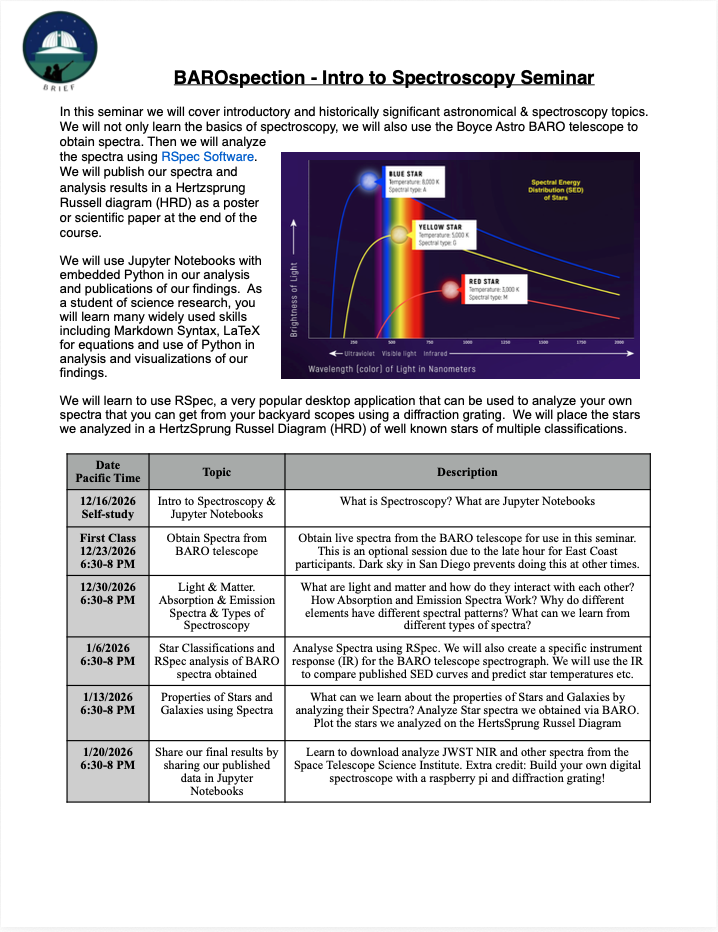
BAROSpection - Introduction to Spectroscopy 2026 course flyer

Add yourself to the waitlist for this Seminar Class Starts Apr 28, 2026


SLACK CHANNEL FOR ALL COMMUNICATIONS! - Please look here for Q&A

NEWS - READ THIS SECTION BELOW FOR UPDATES EACH TIME!

Our workshop will cover a smattering of interesting or historically significant Spectroscopy topics in no particular sequence.  However, the main goal of this course is to teach critical college and research skills that you will need as a student & professional. We will attempt to develop these skills primarily on Spectroscopy related topics as you clearly are astro enthusiasts! The primary audience for this course are High/Middle School, College students, or Early Career professionals. We also care about accessibility of these resources across student communities who may be underrepresented and of a diverse socio economic background. We hope to keep these resources free and open for use as much as possible to anyone who may be interested. Please contact me at drunarayan@gmail.com if you would like to learn more about this course.

Skills we will teach include:

  1. Jupyter Notebooks (the backbone of JupyterLab)
  2. JupyterHub & JupyterLab (dev environment for Jupyter Notebooks adopted widely by universities)
  3. Markdown Syntax (dynamic text, images, video and code embedded publishing)
  4. LaTeX (web and github enables equation editor for research)
  5. Python (language of choice for data science and STEM publications)
  6. Matplotlib (plotting large amounts of data)
  7. Pandas & Numpy (dataframes and math libraries for Python)
  8. SQL (structured query language for querying astro databases)

We expect to run for a total of 8 sessions every Tuesday starting Apr 28, 2026. Look for a Google Meet schedule links to be available at this page ahead of the workshop start date.

Please check this link below for ALL UPDATES.  I will try not to send emails or notifications for any updates.  All materials will show up on this link below.  So please bookmark it check it frequently.

What is Jupyter?

If you are not familiar with Project Jupyter, and JupyterHub, I highly recommend learning about them by following the embedded links.

All of the content provided here are accessible to you using a combination of technologies provided by Jupyter and Github where 83+ million researchers around the world come together to publish the share their work.

You will be accessing your own ‘virtual laptop’ hosted on a Google virtual machine somewhere in the globe to do your work. You class materials will be available to you there and you will store the products of your learning there and not on your physical computer from which you are accessing this course. Your work will be to modify the Jupyter Notebooks to add text, images, video, to write your own code, query and retrieve astronomical databases, analyze and plot your results graphically.

Create your JupyterLab Login for use later!

You will be logging into JupyterHub for getting workshop materials and creating your own Jupyter Notebooks.  Your username is simply <your first name>. followed by the word p4b. For instance, my username would be chandru.p4b. See & use the created usernames below. The first time you log in, create and type in any password you make up yourself.  That will become your actual password for this JupyterHub - please try not to forget it.  If you do, email me at drunarayan@gmail.com, I will reset it. Please see created usernames below.

Workshop organization & JupyterLab - your own virtual laptop in the sky!

Click here to read about the BAROSpection workshop Infrastructure

User Names & Student Assignments

Click here to see Students, Intial Star Assignments, Usernames, Status

Click here to see Student Submissions

Click for FINAL PROJECT Instructions - Analyze Mystery Star and Build Hertzsprung Russell Diagram

Projects & Materials Access

Please complete these steps including Project 0 ahead of the first session

  1. You do not need a Dropbox accout to access images!
  2. Click the link above. It will open in your default browser.
  3. First click down to the “Images” Folder. In the Browser. You will have choices to download
    1. Click down to your “star folder” under “Images” folder. Then Download your specific “Star” folder or some other “Star” folder. You will get a zip file which you can extract on your system.
    2. Download the entire “Images” Folder. You will get a zip file which you can extract on your system. Be warned - this is several GB and wmight take a very long time. Although we may not exceed this limit, Dropbox will prevent you from downloading more than 20GB

Python for Spectroscopy Course Content Notebooks & Assignments

Project Topics Notebook Due Date Partial Solution
0.0. First Access to Slack - Make your first contribution to Slack about your assigned Star! Slack TBD None
0.1. First Login to JupyterHub - Hand compute celestial coordinates for your assigned star Hand Compute CC TBD View Only
0.2. What is JupyterLab - Jupyter Notebooks - Learn Basics Intro to Jupyter TBD View Only
1. Introduction to coding Python inside JupyterLab Intro to Python Part 1 TBD View Only
2. Compute Celestial Coordinates to obtain Live Spectra of Stars Celestial Coordinates TBD View Only
3. Install the RSpec Application on your Windows system for analysis of your star spectra. Please include word “BAROspection” in the form for download RSpec download & Install TBD None
4. RSpec Spectral Analysis First RSpec Analysis of your Star TBD View Only
5a. Calculate Temperature of your star using Wein’s law & build Instrument Response Curve Star temperature & Instrument Response TBD View Only
5b. Identify Spectral lines in your Instrument Corrected Spectrum by using the Walker Spectroscopic Atlas RSpec Image of your Star showing Identified Spectral Lines TBD View Only
6. More Advanced topics in Python Intro to Python Part 2 None. For reference and help only View Only
7. Numpy and Pandas libraries for numerical calculations and learning to use Dataframes Intro to Numpy TBD View Only
8. Visualizations and Animations Intro to Visualization TBD View Only

Light & Matter and Electromagnetism

  1. What is Light?
  2. Electromagnetic Waves
  3. Photons & Matter
  4. Class Jupyter Notebook - Light Basics View Only

Light & Matter Interactions

  1. What is a Blackbody
  2. Electromagnetic Spectrum
  3. Modeling a Black Body
  4. Waves & Particles
  5. Jupyter Notebook - Light & Matter Interactions View Only

Spectroscopy

  1. What is Spectroscopy
  2. Types of Spectra
    1. Continuous Spectrum
    2. Absorption Spectrum
    3. Emission Spectrum
  3. Source of Spectral Lines
  4. Calculating Balmer’s Constant
  5. Doppler Effect on Spectral Lines
  6. Jupyter Notebook - Absorption & Emission Spectra View Only

Star Properties

  1. Star Types
  2. What can you learn from Star Spectra
  3. HertzSprung Russell Diagram (HRD)
  4. Plot an HRD for Sun’s 100 Parsec neighbourhood
  5. Final Project - Mystery Stars & HRD
  6. HRD Presentation

Obtain Live Spectra from the BARO Telescope

  1. Spectral Grating configuration on BARO
  2. Selecting Targets in the Solar Neiborhood
  3. Create Target List for Hot & Cool Stars & Nebulae
  4. Schedule to obtain Spectra
  5. Calibrate using RSpec

Analyze & Publish Spectral Images using RSpec

  1. Annotated HR Diagram
  2. Use RSpec to Analyze Spectral Lines
  3. Measure Wavelenghts & Frequencies
  4. Measure Shift in Spectral Lines
  5. Compare against NIST Standard
  6. Publish your results in a Jupyter Notebook
  7. Post examples to RSpec website

References for creating your descriptions about your calibration and assigned stars

  1. Walker Spectroscopic Atlas from Astrosurf: Use this amazing resource to look at professional calibrated spectra of stars of all types. This is a very useful document to use in yoru analysis of calibrated RSpec spectra of your star and identification stellar elements. Look up the Stellar type and see if you can identify absorption/emission features identified for the specific stellar type in your own spectrum. If you do identify it, annotate the spectrum with the wavelength and the element noted! You will be using this reference to fully complete your annotated spectra and Jupyter Notebook assignment #4: light_basics_assignment_with_rspec.ipynb.

  2. The 02B_Celestial_Coordinates.ipynb notebook you already completed contains a cell which produced many reference links that can also be used to get much more information about your star. These should be used to describe everything you discovered about your star with external pictures, text and any interesting observations. You will be using this reference to fully complete your annotated spectra and Jupyter Notebook assignment #4: light_basics_assignment_with_rspec.ipynb and beyond.

  3. Online OpenStax Astronomy Textbook An excelent online Astronomy textbook written and maintained by over 30 academics. I highly recommend that you use this resource for clarifications of concepts in Astronomy, and specifically Spectroscopy. I recommend reading Chapter 5 in its entireity.

  4. Astro 801 - A penn state online undergraduate study in Astronomy

  5. Stars are not Blackbodies Here is an excellent paper on why estimating star surface temperatures using Wein’s displacement law could be inaccurate. However, you can get a rough estimation.

  6. How to create an instrument Response profile for BARO. Follow this excellent video from Tom that shows how to create an instrument response profile on your own and apply it to a mystery star!

  7. Download Pre-created Instrument Response File for BARO

  8. HR Diagram References

  9. Use this notebook to explore your Mystery Star!

Item Status Date Topic Google Meet Link Google Recording Link
1a Posted Tue, Apr 28, 2026 6:30 - 8:00 PM Pacific Time Intro to Spectroscopy & Jupyter Notebooks Google Meet link The recording from the following session contains the full 3.5 hours from Aug 15th
1b Posted Tue, Apr 28, 2026 8:00 - 11:00 PM Pacific Time OPTIONAL - Obtain Spectra from BARO telescope Google Meet link Google Meet Recording from 2025 Seminar
2 Posted Mon, May 04, 2026 6:30 - 8:00 PM Pacific Time OPTIONAL - Informal/Friendly Walkthrough of RSpec by Mr. Tom Field Zoom link Tom Field’s RSpec Meeting Recording
3 Posted Tue, May 05, 2026 6:30 - 8:00 PM Pacific Time Light & Matter. Absorption & Emission Spectra & Types of Spectroscopy Google Meet link Google Meet Recording from 2025 Seminar
4 Posted Tue, May 12, 2026 6:30 - 8:00 PM Pacific Time Star Classifications and RSpec analysis of BARO spectra obtained Google Meet link Google Meet Recording from 2025 Seminar
5 Posted Thu, May 19, 2026 6:30 - 8:00 PM Pacific Time OPTIONAL - Photonics Guest Lecture by Demis John!! Google Meet link Google Meet Recording from 2025 Seminar
6 Posted Tue, May 26, 2026 6:30 - 8:00 PM Pacific Time Hertzsprung Russell Diagram and Final Project TBD Google Meet link Google Meet Recording from 2025 Seminar
6 Posted Wed, Jun 02, 2026 6:30 - 8:00 PM Pacific Time TBD Google Meet link Google Meet Recording from 2025 Seminar
7 Posted Tue, Jun 09, 2026 6:30 - 8:00 PM Pacific Time Share our final results by sharing our published data in Jupyter Notebooks Google Meet link Google Meet Recording from 2025 Seminar